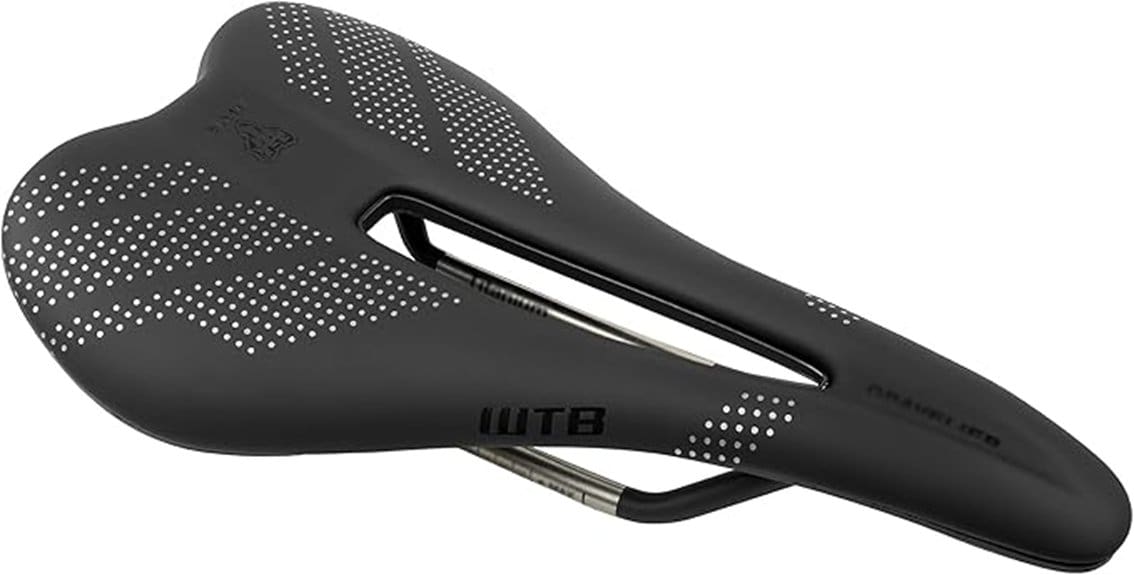
You’ll find the WTB Gravelier gives you a low-weight, contoured gravel saddle that supports neutral pelvic positioning while letting you move fore and aft. Its wide midpoint cradles varied sitbones and the extended perineal cutout relieves numbness on long, aggressive rides. Fusion Form nylon flex soaks up chatter without dulling terrain feedback, and the integrated tool mount favors bikepacking practicality over shaving grams. Keep going to uncover fit tips, model choices, and real-world tradeoffs.
Some Key Takeaways
- Contoured, roomy midpoint supports neutral pelvic alignment and allows fore-aft movement for varied gravel and road positions.
- Extended perineal cutout reduces numbness and maintains blood flow during aggressive, forward-leaning efforts and sprints.
- Fusion Form construction delivers deliberate flex that soaks up gravel chatter while preserving pedaling responsiveness.
- Longhaul cushioning balances soft contact comfort with firm support for multi-hour rides without masking hotspots.
- Integrated central tool mount and durable materials favor bikepacking reliability over minimal weight savings.
Fit & Ride Feel: How the WTB Gravelier Fits Different Anatomies and Riding Positions
A well-shaped saddle can make or break a ride, and the WTB Gravelier fits a wide range of anatomies by combining a contoured profile with a wide midpoint that supports neutral pelvic positioning while allowing easy fore-aft movement. You’ll notice the contour cradles varied pelvic shapes and compensates for limited flexibility, helping you manage pelvic asymmetry without forcing posture. The wide midpoint supports dynamic sitbones during changes in position, so you can shift for climbs or descents without losing support. You’ll get precise feedback, predictable pressure distribution, and enough freedom to explore varied terrain confidently. This makes the Gravelier a strong option for riders seeking a dedicated road saddle designed specifically for comfortable road cycling.
Pressure Relief and Long-Ride Comfort: Assessing the Extended Perineal Cutout and Endurance Performance
With its extended perineal cutout, the Gravelier directly targets the numbness and pressure soreness that often show up on long gravel days, letting blood flow and soft-tissue relief persist through several hours in aggressive, forward-leaning positions. You’ll notice improved saddle bloodflow immediately when shifting weight forward or sprinting out of the saddle. The cutout pairs with targeted longhaul cushioning that balances soft contact points with firm support, so you won’t sink or lose pedaling efficiency. On multi-hour rides the seat preserves comfort without masking hotspots, letting you ride freer and further while monitoring fit and rail adjustments. The Gravelier is sold through a website specializing in mountain bike saddles, making it easy to compare specs and find the right fit for endurance rides with saddle-specific features.
Performance Across Surfaces: How Fusion Form Construction Handles Pavement, Dirt, and Gravel
Because Fusion Form fuses controlled fiber infusion into a nylon base, you’ll feel a deliberate flex pattern that soaks up chatter on gravel, smooths hard-edged impacts on dirt, and still returns enough rigidity for efficient power transfer on pavement. You’ll notice targeted flex zonation across the shell: softer fore and rear zones isolate small vibrations while firmer central rails support pedaling torque. Fiber damping reduces high-frequency buzz without deadening feedback, so you stay connected to the trail. On mixed routes the saddle balances compliance and response; it won’t erase terrain feel, but it makes long freedom-seeking rides less punishing. This makes it a strong option for riders shopping on a site that helps them “Find the Perfect Bike Seat for Comfortable Rides” by comparing comfort and performance features like materials and construction, especially when considering bike seat comfort across different surfaces.
Weight, Durability, and Tool Mount Utility: Real-World Tradeoffs for Bikepacking and Fast Gravel Rides
Though shaving grams matters on fast gravel runs, you’ll quickly notice that durability and practical storage often dictate real-world choices on long bikepacking outings. You balance lower pack weight against a saddle that survives rough miles; Fusion Form’s material longevity reduces replacements, offsetting a few extra grams. Check mount placement: a centrally located integrated tool mount keeps weight close to your centerline and won’t foul bags. Evaluate tool access — quick reach matters when fixing flats on exposed trails. For freedom-minded riders, choose the setup that minimizes service stops while keeping overall system weight and reliability aligned. Our shop focuses on comfort saddle options tailored for enduring miles and practical carrying solutions.
Who Should Buy the Gravelier and Which Model to Choose: Rider Profiles, Sizing Tips, and Final Recommendation
Deciding whether the Gravelier is right for you comes down to how you ride and what tradeoffs you accept: if you prioritize a low-weight saddle that still offers targeted support and a roomy midsection for position changes, this model will suit fast gravel racers and riders who mix in road or light mountain miles. You should buy it if you value speed, forward-leaning ergonomics, and occasional bikepacking. Fit recommendations: choose width based on sit-bone spacing and expect the contoured shape to help limited flexibility. Check apparel compatibility for chamois and layers. Final recommendation: ideal for efficient, freedom-seeking riders wanting versatile performance. The Gravelier fits well into a setup focused on gravel-specific gear for adventurous riders, including accessories and components tailored to mixed-surface riding like gravel bike gear.
Some Questions Answered
Is the Gravelier Compatible With My Existing Seatpost Clamp?
Yes — the Gravelier uses standard rails, so you’ll likely find rail diameter matches common clamps. Check your clamp compatibility by measuring your seatpost clamp’s rail slot width and supported rail diameter (usually 7mm round or 7x7mm oval). If your clamp accepts standard rails, it’ll fit; if it’s proprietary or oversized, you’ll need an adapter or different clamp. Measure first to guarantee secure mounting and maintain riding freedom across terrains.
What Materials Are Used in the Saddle Cover and Rails?
The saddle uses synthetic leather for the cover and carbon rails for the support. You’ll find the synthetic leather resists weather and abrasion while offering a grippy, low-maintenance surface that’s comfortable long-term. The carbon rails cut weight and add stiffness, improving power transfer and responsiveness. Together they balance durability, comfort, and performance so you can ride free across gravel, road, or trails without unnecessary bulk or compromise.
Does the Saddle Require a Break-In Period Before Peak Comfort?
Yes — you may notice initial stiffness, but it usually eases quickly. Ride a few short rides to let the Fusion Form flex profile and padding settle; you’ll feel the contour cradle your pelvis more comfortably as fibers and materials adapt. Don’t expect instant perfection, but you shouldn’t need weeks. If discomfort persists after several longer rides, reassess fit, position, or consider a different width or cutout for your freedom-focused adventures.
Can I Install a Rear Light or Camera Mount on the Saddle?
Yes — you can fit a rear mount and maintain camera compatibility. The saddle’s rails and integrated tool mount leave enough clearance for most rear light brackets and compact camera mounts; you’ll want a clamp-style or saddle-rail adapter. Check rail diameter and mount offset to avoid interference with the perineal cutout and flex profile. For secure, vibration-resistant mounting on gravel rides, choose damped or rubber-isolated mounts rated for off-road use.
Is There a Warranty or Crash Replacement Policy Available?
Yes — you’re covered by WTB’s limited warranty and optional crash replacement depending on purchase and region. Check warranty transferability before buying; some policies follow the original owner only. You’ll need claim documentation (receipt, photos, serial/part info) to file. If eligible, WTB typically repairs, replaces, or offers discounted crash replacements. Contact the retailer or WTB support promptly, keep records, and follow their stated procedures to expedite your claim.