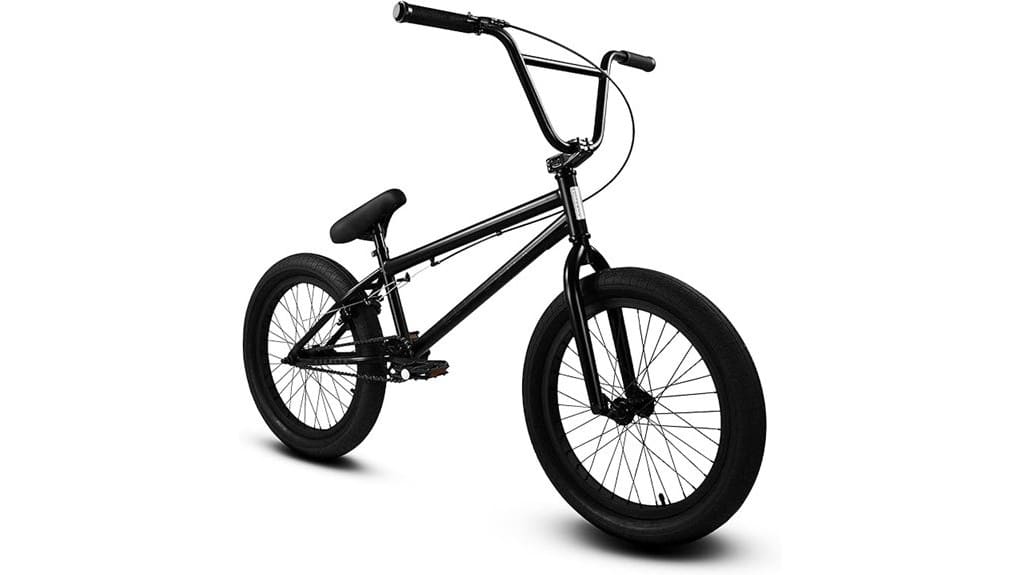
You’ll find the Elite BMX is a tough, predictable freestyle bike that suits youth commuters and stunt beginners who want forgiving yet responsive handling. Its steel frame and fork give consistent steering and impact soak, while 3-piece cranks, a 9T driver, alloy stem, and peg-ready spacing keep service simple and performance steady. Tire profiles and geometry favor planted grip on streets and ramps. It’s a solid entry-to-mid option — keep going to see sizing, parts, and upgrade advice.
Some Key Takeaways
- Durable steel frame and fork offer predictable handling and impact absorption for entry-to-mid-level riders.
- Available in 16″, 18″, 20″, 26″, and 29″ to match rider height and stunt or commuting needs.
- Stock 3-piece crank, sealed bearings, and 9T driver deliver immediate power transfer and resistance to flex.
- 20×2.4 (16×2.4 on small) tires plus peg-ready axles provide reliable grip, grind capability, and stunt readiness.
- Good value for beginners: straightforward maintenance, upgrade paths, and steady resale with proper service.
Who the Elite BMX Freestyle Bike Is Best For
Who needs the Elite BMX Freestyle Bike? You do if you want a dependable platform for urban mobility and learning tricks. You’re a youth commuter seeking nimble handling and robust hardware for daily routes, or a stunt beginner needing a forgiving yet responsive setup. You’ll appreciate the steel durability, peg-ready axle spacing, and predictable geometry that won’t punish experimentation. You’ll value straightforward maintenance and component choices that scale with skill. You’ll expect freedom to explore streets, parks, and ramps without overcomplicated systems. Choose the Elite when you need clarity in performance and room to grow your riding vocabulary. The bike pairs well with essential BMX gear like helmets, pads, and spare parts for safer, longer sessions.
Frame, Fork, and Fit : Choosing the Right Size (16″, 18″, 20″, 26″, 29″)
When selecting frame and fork sizes for the Elite BMX Freestyle Bike, match the wheel size to your height and intended use to maintain proper control and stunt clearance. You’ll choose 16” for small children, 18″ for intermediate builds, 20” for most teens and adults, or the new 26″ and 29″ for taller riders seeking rolling momentum. The steel frame and fork prioritize rigidity; measure stand-over and reach to make certain clearance and predictable handling. Assess wheel clearance for tricks and abrasion tolerance. Check seat ergonomics—height, padding, and clamp range—so you can move freely and ride without restriction. Consider the frame material when choosing a bike, as different materials affect weight, durability, and ride feel.
Key Components and Hardware That Affect Performance (3-Piece Crank, 9T Driver, Stem, Pegs)
Because these small parts dictate how the bike responds under load and in the air, you should inspect the 3-piece crank, 9T driver, stem, and pegs for materials, fit, and durability before riding hard. You’ll notice crank durability on the Stealth 20’s 3-piece design: steel arms resist flex and bearings should be sealed. Driver engagement from the 9T unit gives immediate power transfer and predictable rear-wheel behavior for tricks. Stem reach is fixed at 50 mm on the alloy top-load stem, balancing control and freedom of movement. Peg placement and material affect grind stability and weight; confirm tight mounting and weld quality. For optimal pedal feel and efficient power transfer, consider optimizing your pedal setup to match your riding style and pedal platform pedal setup.
On-Road and Park Riding: Tires, Handling, and Real-World Performance
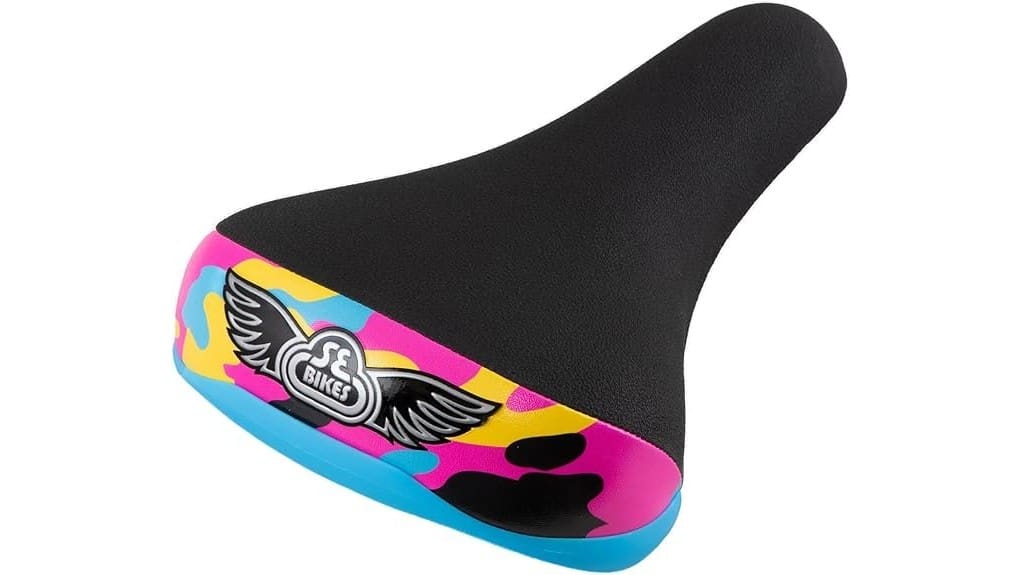
Often you’ll notice the Elite BMX Freestyle Bike feels planted and predictable on both streets and in the park, thanks to its 20 x 2.4 tires (or corresponding 16 x 2.4 on the smaller model) and a steel frame that resists unwanted flex. You steer confidently: tire grip is consistent across rough concrete and wooden ramps, translating inputs without surprise. Acceleration is direct, braking predictable, and the chassis soaks impacts while keeping balance. Cornering stability comes from tire profile and frame geometry working together, letting you push lines and improvise. Real-world performance rewards bold riding and precise control. For riders seeking optimal comfort and performance, choosing the right saddle can make a big difference, especially when considering mountain bike saddles.
Final Verdict and Buying Recommendations (Value, Sizing Checklist, When to Upgrade)
Although the Elite BMX Freestyle Bike prioritizes durable steel construction and proven components, it delivers clear value for riders seeking a reliable, entry-to-mid-level park and street machine. You get long term durability from the frame and basic hardware, steady resale value if you keep service records, and simple replacement paths like the 3-piece crank on the Stealth 20. Follow a strict maintenance schedule—check bearings, brakes, and pedals after hard sessions. Sizing checklist: choose 16″, 18″, 20″, 26″ or 29″ to match height and intent. Upgrade when parts wear, skills outpace stock, or you need lighter, higher-end tech. For more options related to pedal selection and compatibility, consider exploring Perfect Pedals to match your riding style and replacement needs.
Some Questions Answered
Does the Bike Include a Warranty or Service Plan?
No, the bike typically doesn’t include a bundled limited warranty or scheduled maintenance plan from the retailer; you’ll need to confirm with the seller. You’re free to purchase a manufacturer limited warranty or third‑party service package if offered. Inspect frame, forks, and hardware during pickup, and schedule regular maintenance for bearings, drivetrain, and brakes. That keeps your steel frame and components performing reliably while you ride without restrictions.
Can I Convert It to Single-Speed or Add Gears?
Yes — you can convert it to single-speed or add gears, but you’ll need to manage chain tension and possibly perform a hub conversion. You’ll install a single-speed cog or freewheel, adjust or replace the axle for proper chainline, and add tensioners or a horizontal dropout kit. For gears you’ll need a compatible hub conversion, derailleur hanger solution, shifter, and cable routing. You’ll keep it simple and ride free.
Are Replacement Parts Readily Available Locally?
Yes — replacement parts are generally available locally. You’ll find common items like tires (20 x 2.4, 16 x 2.4), pegs, stems, and drivers through bike shops and local suppliers. Aftermarket compatibility is strong for standard BMX components (3-piece cranks, 9T drivers), so you won’t be boxed in. You’re free to source upgrades or repairs locally; technical parts may require a specialty shop but are still obtainable.
What Is the Bike’s Weight for Shipping and Lifting?
You’ll see a shipping weight around 30–35 lbs for most 20″ and 18″ models, slightly less for 16″ and more for 26″/29″ variants; that’s the shipping weight carriers list. For lifting effort, expect moderate effort — you’ll lift and maneuver comfortably if you’re used to bikes, but it’s bulky due to steel frame and accessories. Plan for two hands or a helper when loading into vehicles to reduce strain and avoid awkward angles.
Is Assembly Required, or Comes Fully Assembled?
It needs assembly — you’ll receive the bike partially disassembled in the box and will mount the front wheel, handlebars, pedals, and pegs. You’ll follow the included manual and torque specs to guarantee safe operation. Warranty coverage remains valid if you assemble per instructions and register the bike; keep proof of purchase. You’ll appreciate the straightforward setup that gets you back on the road quickly and under your control.