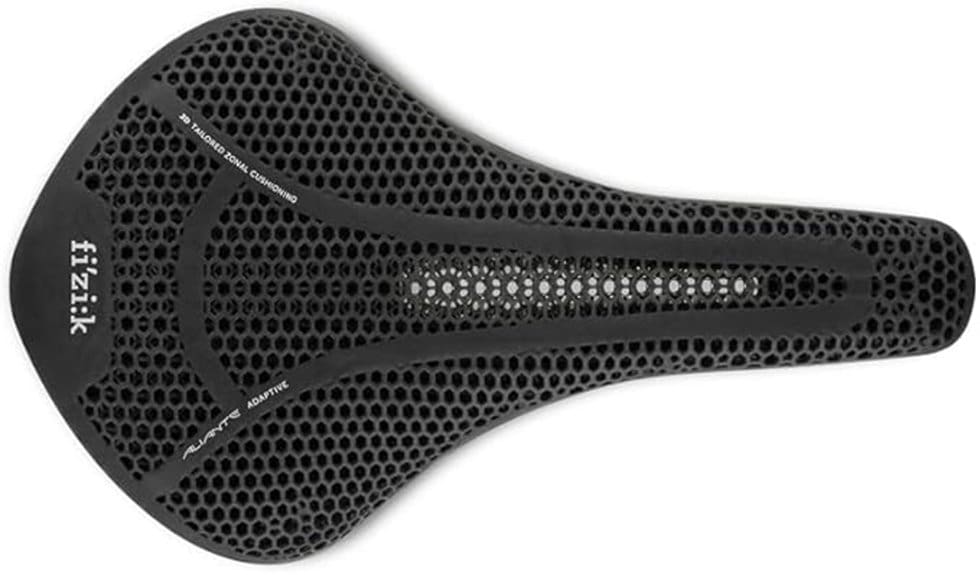
You’ll find the Tempo Aliante Adaptive gives predictable long‑ride comfort without sacrificing performance. It uses a waved platform and 3D‑printed Adaptive padding to spread load, cut hotspots, and let you shift positions with steady support. The carbon shell and rails keep weight low and flex consistent, while zonal lattices tune firmness where you need it. It’s best for endurance riders seeking pressure relief and durability; keep going for detailed fit, specs, and on‑bike feedback.
Some Key Takeaways
- The Tempo Aliante Adaptive delivers standout long‑ride comfort with waved platform and 3D‑printed zonal padding that reduces pressure hotspots.
- Its wider 145 mm platform and zonal cushioning suit varied pelvic angles, supporting both forward‑leaning and upright positions.
- Carbon shell and rails keep weight low (0.46 kg) while providing predictable flex and precise fore‑aft adjustment.
- Pressure mapping and on‑bike testing show reduced peak pressures, less mid‑ride fidgeting, and clearer sustained power transfer.
- Best for endurance riders seeking durable, minimal break‑in comfort; potential cons are premium price and fit limitations for some anatomies.
Saddle Comfort and Fit Summary: Who the Tempo Aliante Adaptive Suits
Because it’s built around a waved profile and 3D-printed Adaptive padding, the Tempo Aliante Adaptive suits riders who need stable, long-ride support without pressure hotspots. You’ll find its wider platform and zonal cushioning lets you test varied pelvic angles comfortably, reducing shifts and chafing over hours. It’s engineered for diverse rider profiles—agile enough for forward-leaning positions, forgiving for more upright postures—so you retain freedom to move. The 145 mm unisex sizing and gender neutral intent simplify selection: pick by sit-bone width and riding goals. Expect consistent support, predictable pressure distribution, and fewer mid-ride adjustments. The saddle is ideal for those focused on long-distance road cycling with an emphasis on comfort and endurance, especially when matched to your sit-bone width.
Construction and Tech Deep Dive: 3D‑Printed Adaptive Padding, Carbon Shell, Rails
While traditional foam limits how cushioning behaves under load, the Tempo Aliante Adaptive uses 3D‑printed Adaptive padding to tune mechanical response across the saddle, so you get distinct zones that compress, rebound, and distribute pressure where needed. You’ll notice 3D printing innovation lets Fizik place softer central cells and firmer perimeter lattices without compromise. A carbon shell keeps overall weight low and provides predictable flex, while carbon rails maintain strength and precise fore‑aft adjustment. Material durability is addressed through engineered lattice geometry and resin selection, so the saddle sustains repeated loading without losing targeted support or altering ride feel. The site offers a range of compatible accessories and replacement parts to help riders find the best fit for their bike seat setup.
On‑Bike Performance: Pressure Relief, Stability, and Long‑Ride Feedback
When you settle into the Tempo Aliante Adaptive for a long ride, the waved platform and zonal 3D‑printed padding immediately change how pressure is distributed across your sit bones and perineum. You feel lower peak points; pressure mapping confirms broader contact and reduced hotspots. The saddle’s wider, tapered profile gives predictable support when you shift positions, so you maintain ride stability through climbs and sprints. Long rides show progressive comfort rather than fatigue—less need to fidget, clearer power transfer. If you want freedom to push duration and intensity, this saddle delivers measured pressure relief and stable, confidence‑inspiring performance. This makes it a strong match for cyclists seeking high‑quality cycling shorts to maximize comfort on extended rides.
Technical Specs, Sizing, and Compatibility Checklist for Bike Setups
Before you fit the Tempo Aliante Adaptive, confirm the key technical specs and compatibility points so you don’t run into fit or installation issues: the saddle is a unisex 145 mm width R1 model with carbon shell and rails, 3D‑printed Adaptive zonal padding, 0.46 kg weight, and Fizik part number 70F7D00A0P002; verify your seatpost clamp accepts carbon rails and the rail spacing/diameter matches standard road saddle rails, check saddle height and setback range will suit your biomechanics given the slightly wider waved platform, and note the two‑year warranty and package dimensions for logistics.
Check saddle dimensions against your contact points, confirm rail compatibility, clamp torque, and clearance with seat tube, bottle cages, or frame. Adjust setback in small increments and test on a familiar route before committing to long rides. Consider pairing the saddle with a stable repair stand and proper clamping when making adjustments.
Final Verdict and Buying Recommendation: Pros, Cons, and Who Should Buy
If you’re chasing long-ride comfort without sacrificing performance, the Tempo Aliante Adaptive delivers—its waved platform and 3D‑printed zonal padding give targeted support and pressure relief so you stay stable and comfortable over extended miles. You’ll appreciate its tailored comfort, carbon construction, and minimal break in period, which get you riding sooner. Pros: excellent pressure management, lightweight build, strong long term durability. Cons: premium price, niche fit for some anatomies, modest maintenance needs for rails and shell. Buy it if you value endurance performance, predictable resale value, and want freedom to ride farther with confidence. Designed for riders who favor gravel and mountain disciplines, it complements bikes built for off‑road comfort.
Some Questions Answered
Is the Saddle Compatible With Dropper Posts or Only Road Seatposts?
Yes — the saddle works with dropper posts as well as road seatposts. You’ll find standard rails and carbon rail compatibility, so dropper compatibility is straightforward; many riders use seatpost adapters or clamp replacements to fit varied dropper heads. You’re free to choose a compatible clamp or adapter to match your dropper’s rail width and profile. Trust the specs and use proper adapters for secure mounting and reliable long-ride comfort.
Can the Adaptive Padding Be Replaced or Serviced?
No — you can’t practically replace the 3D-printed Adaptive padding; Fizik didn’t design modular replaceability options for the integrated foam. You’ll maintain longevity by following a conservative maintenance schedule: keep the saddle clean, avoid prolonged UV/moisture exposure, and check rails and shell for damage periodically. If cushioning degrades, you’ll need to replace the whole saddle rather than service the internal Adaptive padding components.
Is There a Break‑In Period Before Peak Comfort Is Reached?
Yes — you’ll experience an initial adaptation period before peak comfort. Expect several rides while the 3D‑printed Adaptive padding undergoes gradual molding to your sit bones and riding style. You’ll notice progressive pressure relief and stability gains; don’t rush saddle swaps or drastic fit changes during this phase. Track comfort over varied rides, adjust fore/aft and tilt conservatively, and you’ll unleash the saddle’s full endurance potential.
Does the Saddle Come in Different Color Options Beyond Black?
No, the saddle’s standard offering is black; color variants are limited. You’ll usually find the Tempo Aliante Adaptive in black only, with any alternate shades released sporadically and with limited availability. If you want a specific hue, you’ll need to watch Fizik’s drops or third‑party sellers. You can also customize via bike shops or aftermarket wraps, but expect constraints and potential wait times for nonstandard colors.
Is the Saddle Suitable for Bikepacking With Heavy Loads?
Yes — you can use it for bikepacking with heavy loads, but be mindful of limitations. The waved platform and Adaptive padding aid load distribution and reduce pressure on long hauls, giving stable support. However, check rail strength for your specific rack and pannier setup: the R1 carbon rails are light and stiff but less forgiving under extreme torque or heavy-mounted racks. Reinforce mounting or choose load-aware hardware if needed.