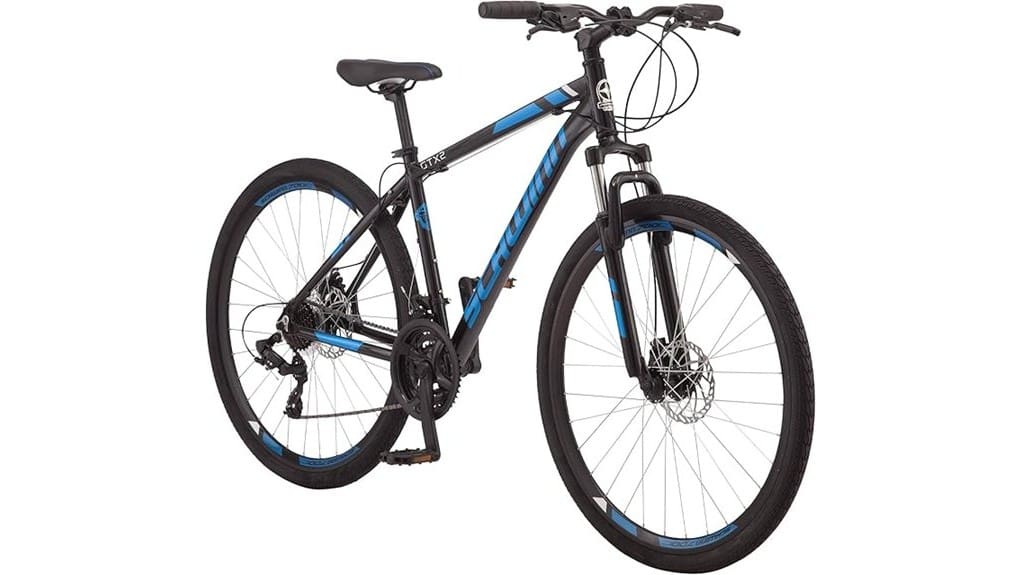
You’ll find the Schwinn GTX Comfort is a practical aluminum dual‑sport hybrid that blends road efficiency with light‑trail comfort for commuting and casual exploration. It uses 700c wheels, alloy double‑wall rims, and a comfort‑tuned suspension fork for steady rolling and controlled traction. The 21‑speed indexed drivetrain with twist shifters is low‑complexity, while linear‑pull brakes are simple to service. Fit favors upright posture for 5’2″–5’9″ riders. Continue for detailed fit, handling, and value comparisons.
Some Key Takeaways
- Aluminum dual-sport frame with suspension fork balances road efficiency and light-trail comfort for everyday commuting and casual exploration.
- 700c wheels and multi-use tires provide efficient rolling and controlled traction across pavement and gravel paths.
- 21-speed drivetrain with twist shifters offers predictable, indexed shifting for simple cadence control and low maintenance.
- Alloy linear-pull brakes deliver straightforward stopping power and easier servicing than disc systems when properly adjusted.
- Fit options (step-through/step-over) and conservative geometry promote upright comfort for riders approximately 5’2″–5’9″.
What the Schwinn GTX Comfort Is and Who It’s Best For
While the Schwinn GTX Comfort targets riders seeking a versatile commuter and light trail bike, its aluminum dual-sport frame and 700c wheels make its hybrid intent clear: it bridges road efficiency and off-road capability. You’ll appreciate the lightweight construction, step-through or step-over options, and suspension fork that smooths varied surfaces. The 21-speed drivetrain and twist shifters provide predictable cadence control, while alloy rims and multi-use tires balance durability and traction. Linear-pull brakes deliver straightforward stopping power. Compared to pure road or mountain models, it suits city commuters and casual explorers who want reliable, liberating performance across mixed terrain. Riders should consider essential gear like comfortable accessories to enhance safety and long-term enjoyment.
Frame, Fit, and Sizing Details for 5’2″–5’9″ Riders
Having established the GTX Comfort’s role as a hybrid between road efficiency and light-trail capability, let’s focus on how its frame geometry and sizing serve riders from 5’2″ to 5’9″. You get an aluminum dual-sport frame available in step-through or step-over layouts; both prioritize a low center of gravity and lightweight responsiveness. Compared to typical commuter frames, the GTX offers conservative reach and slightly shorter top tubes, aiding upright posture and long-range comfort. Adjustable seat height range accommodates leg extension without compromising standover clearance. If you value freedom to explore, this fit range balances maneuverability, pedaling efficiency, and confident mounting. Visit our Perfect Fit page for more on bike sizing.
Ride Performance: Wheels, Tires, Suspension, and Handling
Because the GTX pairs 700c wheels and multi-use tires with an alloy double-wall rim and a suspension fork, you get a balance of rolling efficiency and controlled traction across pavement and light trails. You’ll notice consistent wheel traction on varying surfaces; the rims resist flex under load, keeping tire contact predictable. Suspension responsiveness is tuned for comfort without mush, absorbing chatter while preserving pedaling efficiency. Handling feels neutral compared with sport hybrids: stable at speed, agile in tight turns. For riders seeking open-route freedom, the setup favors confident cruising and exploratory paths rather than aggressive off-road performance. This makes it a practical choice for riders who prioritize touring gear and versatile long-distance comfort.
Shifting, Braking, and Everyday Control (21-Speed, Twist Shifters, Linear-Pull Brakes)
Shift through the GTX’s 21-speed range with twist shifters that deliver rapid, predictable changes and minimal hand movement, letting you keep control in varied conditions. You’ll appreciate the mechanical simplicity: indexed shifting reduces misfeeds compared with friction systems, and routine gear maintenance—lubrication and cable tension checks—keeps shifts crisp. Braking relies on front and rear alloy linear-pull brakes; compared to disc systems they’re lighter and easier to service, though they demand proper pad alignment for consistent brake modulation. Overall, the setup favors autonomy and straightforward upkeep, giving you reliable control on commutes and exploratory rides without complexity. For best long-term performance, apply a suitable chain lube regularly and follow recommended cleaning intervals to protect drivetrain components and maintain smooth shifting chain lubrication.
Value Verdict: Comfort Features, Durability, and Should You Buy It?
Those straightforward controls and reliable brakes set a baseline you can judge the bike’s comfort and durability against. You get a lightweight aluminum frame, suspension fork, and ergonomic geometry that broaden ride options; compared to entry hybrids, the GTX balances compliance and pedaling efficiency. Alloy rims and multi-use 700c tires resist wear, while 21-speed twist shifters deliver predictable cadence control. Consider after sales service and accessory compatibility—racks, fenders, and contact points bolt on without exotic adapters. If you prioritize versatile daily freedom and low-maintenance longevity, the GTX is a pragmatic buy; budget riders seeking premium performance should compare higher-end models. Many riders also value carrying capacity and utility when choosing a hybrid, so check compatibility with rear racks to suit commuting or touring needs.
Some Questions Answered
Does It Come With a Rack or Mounting Points for One?
No, it doesn’t include a rear rack, but it does offer pannier compatibility via common frame mounting points on many models. You’ll find threaded eyelets and sufficient rear triangle clearance compared to commuter-specific bikes, so fitting a rear rack and panniers is straightforward. You’ll want a rack matched to the 700c wheel and step-through or step-over geometry for ideal load balance, preserving the bike’s lightweight, multi-use versatility and rider freedom.
Are Fenders Included or Compatible Accessories Available?
Fenders aren’t included, but you can fit compatible accessories: you’ll mount full-coverage or clip-on fenders to the frame and fork for city commuting. Compared to integrated systems, aftermarket fenders offer superior mud clearance options and modularity, letting you prioritize weight or protection. You’ll verify clearance around the 700c wheels and suspension fork, choose alloy- or plastic-mounted designs, and expect straightforward installation that preserves ride freedom and versatility.
What Is the Bike’s Total Weight (Ready-To-Ride)?
The bike’s ready-to-ride weight is about 30–33 pounds. You’ll appreciate that the lightweight aluminum frame weight keeps overall mass down compared with heavier steel hybrids, while component durability (wheels, drivetrain, brakes) balances robustness and weight. That range lets you handle mixed terrain with less effort and more freedom; it’s lighter than many commuter models yet heavier than performance road bikes, offering a practical compromise for versatile riding.
Is There a Warranty and What Does It Cover?
Yes — you get a manufacturer warranty that provides limited coverage. You’ll have frame protection longer than wearable parts; limited coverage typically excludes consumables like tires, brake pads, grips and normal wear. Compared to full-coverage policies, this is restrictive but standard for hybrids. You’re free to pursue extended or retailer warranties for broader protection; otherwise expect warranty claims to focus on structural defects and manufacturing faults, not routine maintenance.
Are Replacement Parts (Fork, Wheels) Readily Available?
Yes — replacement parts are generally available. You can source aftermarket forks and wheels from major bike suppliers; wheel compatibility is high due to standard 700c sizing and alloy rims. You’ll compare OEM versus aftermarket for fit, weight, and steering geometry impact. You’ll want axle type and hub spacing specs to guarantee compatibility. Overall, sourcing parts is straightforward, but verify measurements to preserve handling and warranty conditions.