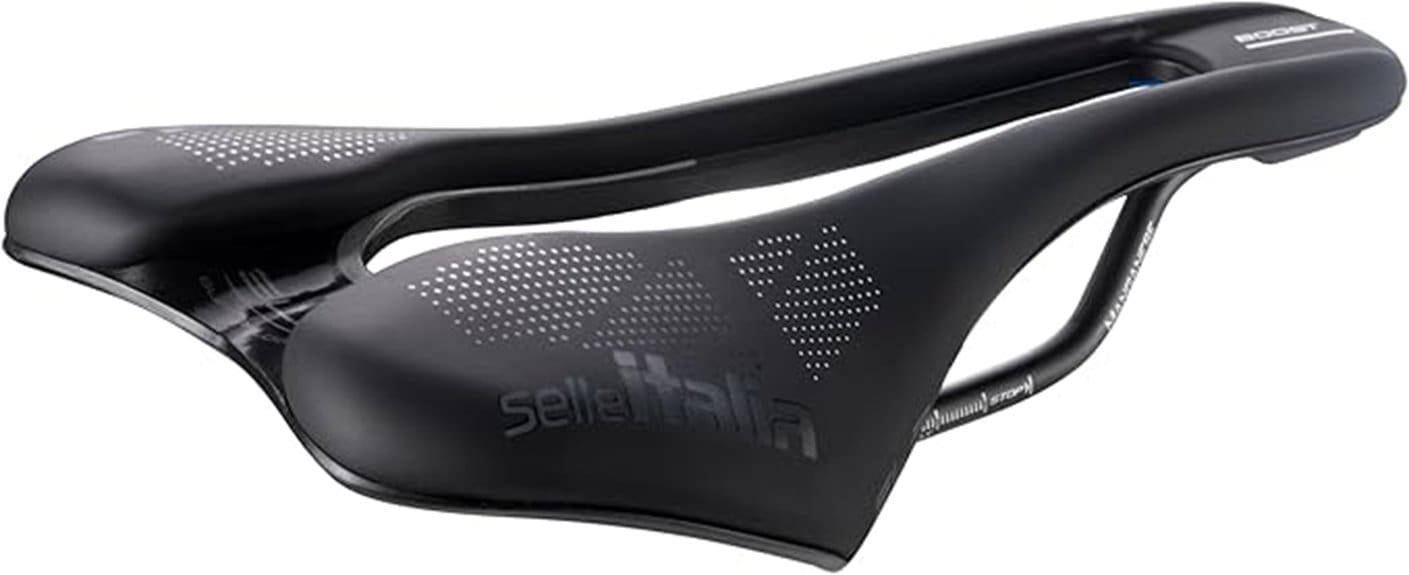
You’ll get a lightweight, short‑nose race saddle built for precise positioning and thigh clearance, with a pronounced Superflow cutout to lower perineal pressure. The 248×130 mm platform on an S3 composite shell and S3 tubular manganese rails feels stiff and responsive, favoring power transfer over plushness. It’s best for racers and fit‑focused riders who accept firmer long‑ride feel; warranty and mid‑range pricing suit value seekers — continue for detailed comparisons and fit notes.
Some Key Takeaways
- Lightweight 248×130 mm race saddle weighing 208 g, optimized for aggressive, forward riding positions.
- Large Superflow cutout reduces perineal pressure and improves thigh clearance for sprinting and climbing.
- Stiff composite shell on S3 tubular manganese rails offers responsive power transfer with limited plushness.
- Short-nose ergonomics prioritize mobility and precise positioning but sacrifice full-length support on long rides.
- Best value for racers and fit-focused riders seeking low mass and pressure relief; less ideal for plush endurance comfort.
Quick Verdict: Who the SLR TM Boost Superflow Is Best For
Although it’s built for performance, the SLR TM Boost Superflow suits riders who prioritize a lightweight, short-nosed race saddle with pressure relief. You’ll appreciate its short nose and Superflow cutout if you value thigh clearance and reduced perineal stress. It targets racers and fit-focused enthusiasts who want minimal bulk without sacrificing support. You’ll find commuter comfort acceptable for mixed-use urban rides, while its construction maintains endurance compatibility for long efforts when paired with a proper bike fit. You should expect precise positioning, low mass, and targeted relief—ideal if you demand freedom of movement and efficient power transfer. Our site helps riders find the perfect seat by offering a range of products related to bike seats for those who enjoy riding bicycles.
What You Need to Know : Key Specs and Build Details
Think of the SLR TM Boost Superflow as a race-focused, short-nosed saddle engineered for low weight and targeted pressure relief: it measures 248 x 130 mm, weighs 208 g, and uses a Superflow central cutout to reduce perineal loading while improving thigh clearance. You’ll get a compact, performance-oriented profile with a short nose and stiff composite shell mounted on S3 tubular manganese rails for predictable flex and minimal mass. The PU cover and durable technical fabric resist wear without excess bulk. ID Match fit principles guide geometry for men; a two-year manufacturer warranty supports longevity and rider freedom. Our site helps riders match frames and components to their riding style and needs.
How It Rides: Fit, Comfort, and Performance on the Road
Having established its dimensions, cutout, and construction, let’s look at how those specs translate on the road. You sit forward naturally; the short nose improves thigh clearance during aggressive pedaling and cornering. The Superflow channel reduces perineal load; pressure mapping shows lower peak pressures centrally and redistributed contact toward the sit bones. At 248 x 130 mm and 208 g, the saddle feels compact and responsive—transfers power with minimal flex from the tubular manganese rails. Long rides remain controlled rather than plush; you trade some padding for mobility and efficient weight transfer, ideal if you value speed and unrestricted movement. This saddle is part of a range designed to help riders find the perfect road saddle for comfortable rides.
SLR TM Boost Superflow vs Similar Saddles: Where It Wins and Loses
When you line the SLR TM Boost Superflow up against other race-oriented short-nose saddles, its combination of a pronounced Superflow cutout, 248×130 mm platform and 208 g weight makes it a clear choice for riders prioritizing perineal relief and nimble thigh clearance without adding mass. You’ll find it wins on short nose ergonomics and targeted pressure redistribution versus longer-profile race saddles. It loses where full-length support or plush padding matter. Rail material differences — tubular manganese rails offer a balance of compliance and price, but carbon-rail rivals deliver lighter weight and greater vibration damping if you demand maximal performance. The site focuses on helping riders choose the perfect mountain bike saddle for comfort and speed, including detailed comparisons of fit and performance for different riding styles and anatomies, especially highlighting mountain bike saddles.
Should You Buy It? Price, Warranty, and Final Buying Recommendation
Although price and warranty aren’t the only factors to weigh, they heavily influence whether the SLR TM Boost Superflow is a smart buy for you: at roughly mid-to-upper range for performance short‑nose saddles it balances a 2‑year manufacturer warranty against a 208 g tubular manganese‑rail construction and Superflow cutout, making it a strong value if you prioritize perineal relief, low mass, and short‑nose ergonomics over the marginal weight savings and damping of carbon‑rail alternatives. Assess price breakdown between retail, sale, and platform fees; factor warranty implications for crash damage and manufacturing defects. Buy if you want freedom-focused fit and proven durability. Our site, Protect Your Ride, also offers a range of compatible helmets and gear to help you stay safe on the road, including guidance on choosing the right cycling helmet.
Some Questions Answered
Is This Saddle Compatible With Carbon Rails or Only Tubular Manganese?
Only tubular manganese rails are specified for this model, so you shouldn’t assume carbon rails compatibility. You can install titanium rails only if the saddle and your seatpost/clamp expressly support tubular manganese-to-titanium interchange; otherwise stick with the manufacturer spec. Using unsupported carbon rails risks clamp slippage or damage. If you want different rail material, choose a saddle variant rated for carbon or titanium rails and verify clamp torque and seatpost compatibility before fitting.
Can the Superflow Cutout Accommodate Users With Prior Perineal Numbness?
Yes — the Superflow cutout can reduce perineal nerve compression and often helps users with prior perineal numbness. You’ll see lower localized pressure on pressure mapping versus solid saddles, which can improve pelvic anatomy load distribution and support preserved sexual function. Individual anatomy and bike fit still matter; you should test the saddle in real rides and consult a clinician if numbness persists to confirm nerve recovery and best positioning.
Does the Saddle Require a Break-In Period Before Optimal Comfort?
Yes — you’ll notice initial stiffness; the composite shell and firm PU cover need mileage. Expect a short break-in as the saddle conforms: gradual padding compression and micro-shaping of the cover reduce pressure points over several rides. Ride progressively, adjust position, and give it 50–150 km before judging comfort. If discomfort persists after that bedding-in, reassess fit, rails setup, or consider a different profile to regain riding freedom.
Is There a Left/Right Specific Orientation for Installation?
No, there isn’t a left/right-specific orientation; you’ll install the saddle centered on the seatpost clamp with its directional fit aligned fore-aft. Check the rails for any manufacturer marks and make sure the Superflow cutout faces rearward toward the rider. Tighten clamps to specified torque, then fine-tune fore/aft and tilt for comfort. The short-nose shape may feel asymmetric until you adjust position to your preferred freedom of motion.
Are Replacement Rails or Covers Available Separately?
No, Selle Italia doesn’t commonly sell Aftermarket rails or replacement covers specifically for this SLR TM Boost Superflow; you’ll typically replace the entire saddle. You can source generic aftermarket rails compatible with tubular manganese dimensions or custom replacement covers from specialist upholsterers, but fit, rail mounting pitch, and material spec may vary. If you pursue parts, verify rail diameter, clamp spacing, and Superflow cutout alignment to make certain safe, comfortable installation and retained warranty conditions.