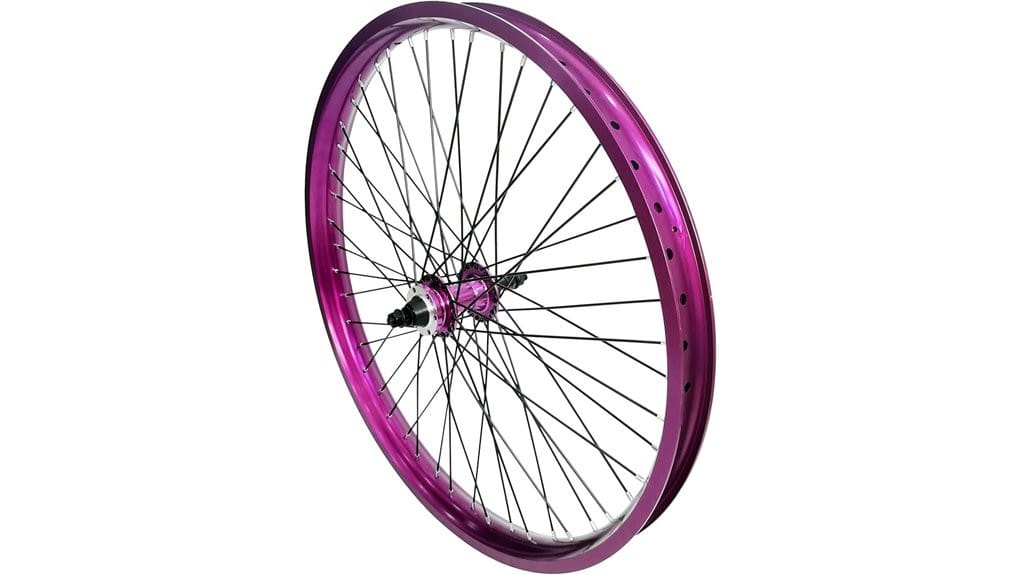
You’ll find a robust 20″/26″ × 1.85″ rear wheel rim engineered for cargo and utility use: a double‑wall aluminum hoop with 47 mm external/39 mm internal width, 48×12‑gauge steel spokes, and 135 mm rear hub spacing that accepts single‑speed through 9‑speed setups plus disc or caliper brakes. It trades weight for load capacity, lowered spoke tension and improved redundancy, but needs careful axle, chainline and nipple corrosion checks. Continue for detailed fit, maintenance and alternative options.
Some Key Takeaways
- Robust double-wall 16.5″ bead rim (420 mm) with 1.85″ external width offers strong load-bearing for heavy-duty rear-wheel use.
- 48 stainless-steel 12-gauge spokes provide even force distribution, redundancy, and improved fatigue life versus single-wall rims.
- Compatible with single-speed to 9-speed cassettes and both disc and caliper brake systems, but verify chainline and rotor clearance.
- Rear hub: 135 mm spacing, 30 mm hub diameter, 180 mm axle length—confirm frame dropout and axle torque specs before installation.
- Heavier, utility-focused design trades speed for payload capacity; consider sealed nipples and routine inspections every 500–1,000 km.
Specs and Fit: Exact Dimensions, Tire and Hub Compatibility for 20″/26″ X 1.85″
While the rim’s labeling as “20”/26″ x 1.85″” can confuse fitment expectations, the precise measured dimensions clarify compatibility: the rim has a 16.5 in (420 mm) bead seat diameter, an external width of 1.85 in (47 mm), and an inner width of 1.54 in (39 mm), so you’ll mount tires rated for 20×2.35–3.5; the rear hub measures 135 mm in width with a 1.18 in (30 mm) hub diameter and an axle length of 180 mm, and the wheel’s design accepts single-speed and 7/8/9-speed multi-speed rotary flywheels as well as disc and caliper brake systems. You’ll evaluate rim circumference against tire selection and confirm bead seatdiameter clearance to guarantee airtight seating, predictable rolling diameter, and hub-to-frame alignment for unfettered mobility. Consider also matching the replacement chain to the drivetrain speed and hub type to ensure smooth shifting and reliable performance with this wheelset replacement chain compatibility.
Construction and Strength: Double-Wall Alloy, 48×12-Gauge Spokes, Load and Durability Expectations
Having confirmed the exact dimensions and compatibility, you can now assess how the rim’s double-wall aluminum alloy and 48×12-gauge spoke configuration affect load capacity and long-term stiffness. You’ll find the double-wall profile increases section modulus, resisting flex under lateral and radial loads, while 48 spokes of 12-gauge steel distribute forces evenly, reducing individual spoke tension and improving collective redundancy. Expect improved fatigue testing outcomes versus single-wall rims; repeated-cycle life extends when spokes and rim are tension-balanced. Aluminum alloy gives weight advantage but demands attention to corrosion resistance at nipples and bed; sealed nipples and periodic inspection preserve strength and service freedom. This setup is well-suited for riders focused on road bike wheels and durable, load-bearing performance.
Brake and Drivetrain Compatibility: Disc, Caliper, Single-Speed and 7/8/9-Speed Fit Notes
Because this rim is engineered to accept both disc and caliper brakes and to accommodate single‑speed through 9‑speed freewheels, you can plan drivetrain and brake integration with predictable interface constraints. The 135 mm rear hub spacing matches common frames; verify axle length and hub spacing against your dropout. If fitting a disc rotor, confirm rotor alignment and caliper mount clearance; the rim’s profile doesn’t interfere. For multi-speed setups, allow precise chainline adjustment to prevent premature wear and maintain shifting accuracy. Check derailleur clearance relative to the wide 47 mm external rim and 48‑spoke flange geometry to avoid interference. Also consider matching the fork’s axle and brake mount standards to ensure full component compatibility with your wheel and frame.
Installation, Maintenance, and Spoke-Tension Checklist
Start by inspecting the wheel on a stable workstand and confirm hub spacing, axle length, and overall trueness before you fit it to the bike. You’ll recheck spoke tension with a calibrated wrench, using incremental quarter-turns to equalize load across the 48 spokes. Verify wheel alignment in the frame and rotor centering for disc brakes. Scan nipples and threads for spoke corrosion, replace any compromised spokes, and lube nipples sparingly. Torque axle to spec, then spin-check for lateral and radial runout under load. Schedule routine inspections every 500–1,000 km or after heavy impacts to maintain safety and freedom. Also ensure you have essential repair-stand gear like a stable workstand to make these tasks safer and easier.
Who This Rim Is Best For and Buying Alternatives
If you ride a utility, cargo, or heavy-duty cruiser and need a robust, low-maintenance rear wheel, this 20″/26″ x 1.85″ double-wall aluminum rim is engineered for you. You’ll appreciate the 48-spoke, 12-gauge build when commuter commuters demand load-bearing reliability and reduced maintenance during cargo hauling. It suits single-speed and 7–9-speed setups, disc or caliper brakes, and wide tires up to 3.5″. If you want lighter touring speed or aero performance, consider higher-gauge spokes and narrower rims from road-specific brands. For more payload capacity, look at reinforced steel rims or purpose-built cargo-wheel assemblies with wider flanges and heavy-duty hubs. For convenient storage of your bike, consider using wall-mounted bike storage hooks to keep wheels off the floor and out of the way.
Some Questions Answered
Is Tubeless Tire Setup Possible With This Rim?
No — it’s unlikely you can run a reliable tubeless setup on this rim. The rim’s bead seat dimensions and 1.54″ (39 mm) inner width suit tube-type tires and wider carcasses, not modern tubeless beads. Without explicit tubeless-ready sealing, rim tape, and compatible bead seat profile, you’ll face air loss and sealant failures. If you insist, convert carefully: reseal, use proper tape/valve, and test pressure/safety before riding.
What Is the Rim’s Weight per Unit?
The rim weight is approximately 980–1,100 grams per unit; you’ll find small manufacturing variance. With its double-wall aluminum construction and 48-spoke, 12-gauge build, it supports a high load capacity — typically rated for heavy-duty use and touring loads. You’ll want to verify the vendor’s spec sheet for an exact gram value, and make certain your intended payload matches the listed load capacity before committing to long-distance or cargo applications.
Does the Rim Come With Spoke Nipples Pre-Installed?
No, the rim doesn’t include pre installed nipples; you’ll need to fit them during wheel build. You’ll want to follow installation tips: lace spokes uniformly, thread 12-gauge nipples to nominal length, then true and tension incrementally. Use a calibrated spoke wrench and dish gauge, check hub bearings and axle alignment, and retension after initial ride. That technical approach preserves strength, distributes load across 48 spokes, and gives you durable, dependable performance.
Is Quick-Release Axle Compatible Without Adapter?
No — it won’t accept a quick release without axle adapters. You’ll need axle adapters to convert the 180 mm solid axle to a quick release system. Verify dropout spacing and adapter thread/shaft compatibility before fitting. Once fitted, tension and alignment must be checked; the 48-spoke, double-wall rim demands precise load distribution. Using correct adapters preserves hub integrity and gives you the freedom to convert safely and reversibly.
What Is the Corrosion Resistance/Coating Used on the Rim?
The rim uses an anodized finish for primary corrosion resistance and a secondary powder coating layer for added abrasion and environmental protection. You’ll get electrochemical oxide barrier from anodizing that resists pitting and galvanic attack, while the powder coat gives mechanical toughness and UV stability. You should still inspect and maintain seals and spokes, as coatings reduce but don’t eliminate corrosion risk under prolonged salt or moisture exposure.