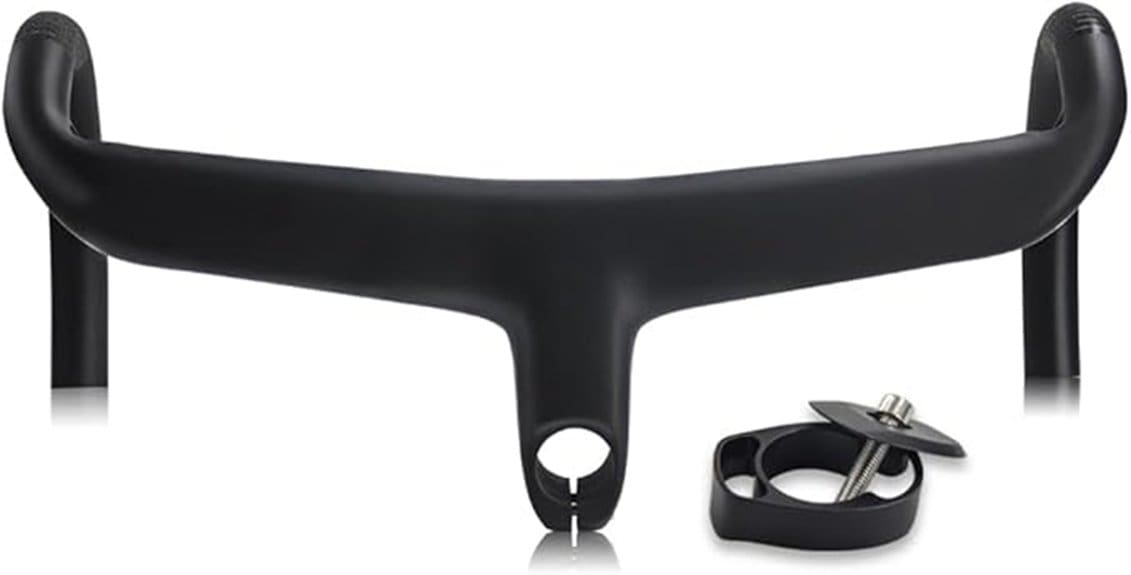
You’ll get an ultralight T700-carbon integrated bar and matched stem that trims weight and clutter while keeping a stiff, predictable front end for fast road riding. It supports full three-hole internal routing, comes in 400/420/440 widths and 90–110 mm stem lengths, and weighs about 360 g for 400×90 mm including accessories. Expect firm compliance, reduced vibration at high frequencies, and strict 4 Nm torque limits; keep an eye on impact sensitivity and warranty—more details follow.
Some Key Takeaways
- Lightweight T700 carbon integrated bar-stem (~360 g for 400×90 mm) reduces cockpit weight versus separate aluminum parts.
- Full three-hole internal routing delivers a clean cockpit and protects cables and hydraulic lines.
- Stiff integrated stem improves steering precision and power transfer, ideal for fast road riding.
- Controlled compliance smooths high-frequency vibration but feels firm on very rough pavé.
- Requires careful installation and 4 Nm torque checks; impact sensitivity and long-term durability are potential risks.
What the RXL SL Integrated Handlebar Is and Who It’s For
Because it integrates a T700 carbon handlebar and a matched stem into a single UD matte unit, the RXL SL is a lightweight, stiff cockpit aimed at road riders seeking weight savings, cleaner cable routing, and a performance-oriented fit. You get an integrated system that reduces parts count, simplifies installation, and supports full internal routing to protect lines. It suits riders who want a sharper position and lower mass—whether you’re a pro rider optimizing aero and feel or making a commuter upgrade for quicker accelerations. You’ll appreciate predictable stiffness, controlled compliance, and straightforward support and replacement channels. Many buyers choose carbon cockpits for their weight savings and improved ride feel.
Key Specs That Matter: Sizing, Weight, Materials, and Routing
Now that you know what the RXL SL aims to deliver, let’s look at the specs that determine fit, feel, and compatibility. You’ll pick widths (400/420/440 mm) and stem lengths (90/100/110 mm) to address sizing nuances; reach (75 mm) and drop (127 mm) keep cockpit geometry predictable. Weight tradeoffs are clear: ~360 g for 400×90 mm including accessories favors lightness over marginal additional damping. Materials comparison favors T700 carbon for controlled elasticity and anti-shock behavior versus aluminum, with aluminum alloy hardware. Three-hole full internal routing benefits protection and cleaner cabling while simplifying installation and reducing wear. Proper use of a torque wrench ensures fasteners on carbon components are tightened to spec to avoid damage.
On-Road Performance: Stiffness, Comfort, and Vibration Damping
When you ride, the RXL SL’s T700 carbon layup and integrated stem create a stiff front end that resists torsion and maintains precise steering under sprinting and hard cornering. You feel direct power transfer during accelerations; stiffness testing shows minimal flex at the clamp and drops. The UD carbon delivers targeted ride compliance—enough flex to smooth small bumps without blunting feedback. Vibration isolation is effective at high frequencies, reducing hand numbness on long rides while preserving road feel. Expect measured comfort tradeoffs: firm on rough pavé but confident and efficient on fast, open roads where you want control and freedom. Designed for cyclists who prioritize handling and weight savings, these bars are a choice for suspension-focused riders.
Installation, Torque Limits, and Real-World Fit Tips
Although the integrated design simplifies fitment, you must follow precise torque and handling steps to avoid damaging the carbon body. You’ll clamp the 1-1/8″ steerer with the supplied adapter, hand-support the carbon while tightening, and set screws to the specified 4 Nm. Perform a torque check with a calibrated wrench after first ride and periodic service. Route cables through the three-hole internal channels, verify pad alignment for brake access, and confirm cockpit symmetry using measured widths (400/420/440 mm). If you swap stem length (90/100/110 mm), recheck alignment and torque to prevent stress concentrations and cracks. For workshop setup and safety, make sure you have the essential bike repair stand and related gear to secure the bike during installation.
Buy or Skip? Value, Risks, and Final Recommendation
Having followed correct installation and torque procedures, you can assess whether the RXL SL Carbon handlebars justify purchase by weighing performance gains against risks and cost. You’ll value lower weight, integrated routing, and controlled elasticity for improved handling, but perform a cost analysis: compare price to aluminum alternatives and expected savings in grams. Consider long term durability and impact sensitivity; follow torque limits to reduce crack risk. Factor warranty coverage and seller responsiveness for defect resolution. Resale value may be moderate—integrated parts limit market. Buy if lightness and clean cockpit matter; skip if you prioritize modularity or maximum robustness. Also consider how flat handlebars fit your riding style and bike setup, since handlebar compatibility can affect comfort and control.
Some Questions Answered
Are Replacement Stem Top Covers Available Separately?
Yes — you can get replacement covers; the package lists a stem top cover and seller support for parts. If you need spare caps beyond the included one, contact the seller for availability, pricing, and shipping. You’ll want to confirm fit with your handlebar size and verify material/finish to match. Keep torque and installation guidance in mind when fitting any replacement covers to avoid stressing the carbon body.
Can I Run Electronic Groupset Wires Through Adapter?
Yes — you can route electronic wiring through the adapter, provided your cable diameter and connector heads fit the internal channels. Check electronic routing clearance against adapter compatibility; some housings or large junctions may block passage. Measure wires and test-fit before final assembly. Use the recommended torque and support the carbon body during tightening to avoid stressing internal passages. If fitment’s marginal, consider external routing or a different adapter.
What Colors or Finishes Beyond UD Matte Exist?
Only UD matte is listed; no other factory colors are specified. If you want gloss finishes or custom anodizing, you’ll need aftermarket options or ask the seller/manufacturer about special runs. You can source third-party finishing services for gloss clearcoats or anodized aluminum parts (stem caps/adapters) but avoid altering carbon surfaces directly. Follow torque/care guidelines after any modification, and confirm warranties before commissioning custom anodizing or finishing.
Is a Torque Wrench Included in the Package?
No, a torque wrench isn’t included. You should use a calibrated torque wrench for torque compatibility and set screws to the specified 4 Nm. You’ll protect the carbon by supporting the body while tightening and avoid over-stress that causes cracks. For maintenance intervals, inspect bolts and routing every few hundred kilometers or monthly if you ride frequently, and recheck torque after initial rides or any impacts to confirm continued safety and performance.
Does Warranty Cover Crash Damage to Carbon Body?
No — warranty exclusions typically bar crash damage to the carbon body. You’ll need to cover crash repairs yourself or seek paid repair services. Document damage with photos and contact the seller for guidance; they can confirm if a safety-related replacement is needed. Keep torque and installation records to support any claim, but expect warranty denial for impacts, cracks, or misuse listed under warranty exclusions.