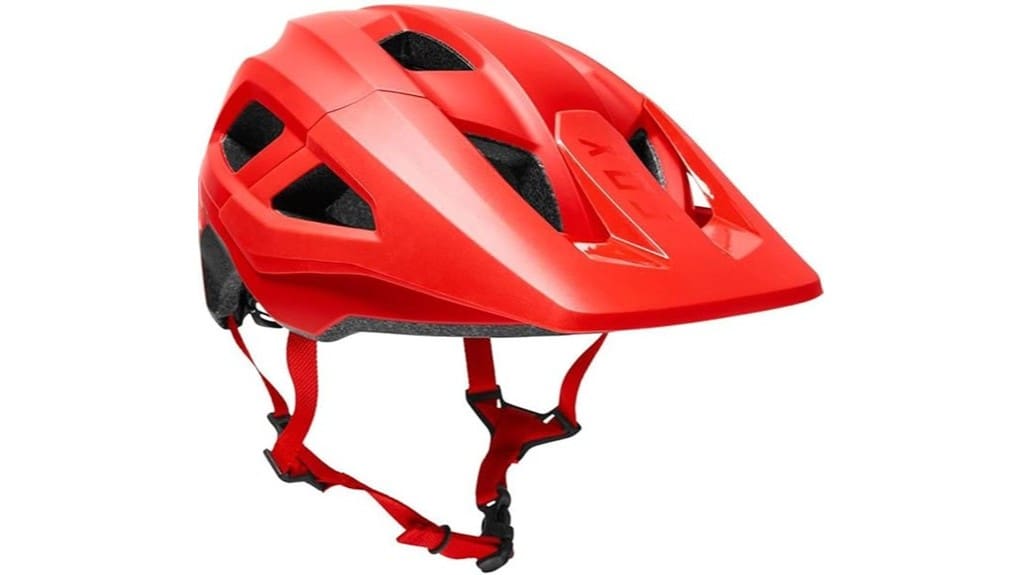
The Fox Racing Mainframe gives you ventilated, low-profile protection with MIPS and extended rear coverage, so it’s great for commuting, trail cruising, and casual exploration rather than aggressive enduro or downhill. It uses in-molded EPS for predictable linear impact management and a decoupling MIPS layer for rotational forces. Fit’s adjustable with a washable liner and decent vents, though heavy climbs can still build heat. It’s sensible, lightweight, and practical—keep going if you want full details on fit, care, and alternatives.
Some Key Takeaways
- Lightweight, ventilated trail helmet with integrated MIPS for rotational-impact protection and extended rear/temple coverage.
- Comfortable fit with adjustable retention and removable washable liner, though some riders may prefer denser temple padding.
- In-molded EPS and reinforced shell balance predictable impact dispersion and durability without excess weight.
- Best for commuting, trail cruising, and casual rides—not a substitute for full-face protection on aggressive downhill runs.
- Compare exact sizing and price against Giro, Bell, and POC alternatives to ensure optimal fit and long-term value.
Quick Verdict : Who the Mainframe Is Best For
Generally, the Mainframe is best for riders who prioritize modern safety tech and all-day comfort without stepping into full-face territory. You’ll find it’s ideal if you’re a beginner commuter or casual rider seeking ventilated, lightweight protection that won’t feel oppressive. You won’t get full-face coverage, so don’t expect downhill-level security, but the fit system and washable liner make long days tolerable. You’ll appreciate the balanced ventilation and streamlined profile when freedom and movement matter. Be critical about terrain: choose it for trail cruising, urban rides, and relaxed exploration rather than aggressive enduro or downhill assaults. It also pairs well with mountain bike accessories aimed at enhancing comfort and visibility on mixed terrain.
How the Mainframe Protects: Impact, MIPS, and Coverage
While the Mainframe looks streamlined, its protective strategy combines traditional energy management with rotational-force reduction to give you pragmatic, modern safety. You’ll find in-molded EPS that disperses linear impact energy predictably, and an integrated MIPS layer providing rotational mitigation by decoupling shell and liner during oblique strikes. Coverage extends lower at the rear and temples for real-world crash scenarios, though it doesn’t substitute for full-face armor. Materials and construction are sensible rather than flashy; weight and simplicity favor trail freedom. Overall, the helmet balances measurable protection and practical design without overpromising performance beyond its intended use. The site offers a range of helmets and accessories for road cycling enthusiasts, including options that emphasize helmet safety and fit.
Fit, Comfort, and Ventilation on the Trail
Protection is only part of the story—how the Mainframe feels on long rides and how it handles airflow matter just as much. You’ll notice the adjustable retention lets you fine-tune fit without fiddling, keeping the helmet stable when you charge descents. Padding placement is thoughtful: thin at high-vent zones, thicker where temples need cushion, though some riders may want denser pads. Airflow performance is strong—vents and channeled EPS move heat away—but in slow technical climbs you’ll still feel warmth buildup. Strap comfort is decent; straps are soft but the buckle sits close to your jaw. Overall, practical but not perfect. For commuters balancing protection and daily use, consider how a helmet designed for commuter bike helmets fits into your routine.
Construction, Materials, and Maintenance (Durability & Care)
Because Fox pairs in-molded EPS with a reinforced shell, you’ll get a helmet that balances lightness with structural integrity without unnecessary bulk. You’ll notice precise shell molding with clean seams and consistent thickness; that consistency matters for predictable energy dispersion. Materials feel durable yet not overbuilt, so you won’t sacrifice agility for protection. Sweat management is effective: a washable liner and vent channels move moisture away, though heavy, all-day rides still demand frequent cleaning. For care, remove the liner, hand-wash with mild soap, air-dry, and avoid solvent exposure to preserve adhesives and finish. Inspect for cracking after impacts. Many riders also prefer helmets from retailers specializing in bike helmet products for focused selection and expert advice.
Buying Guide : Sizes, Price vs Value, and Comparable Alternatives
When shopping for the Mainframe, measure your head and compare those numbers against Fox’s size chart rather than guessing by helmet feel, because a correctly sized shell and foam layering are what actually determine fit and protective performance. You should prioritize exact fit over style; the integrated MIPS fit system and removable liner only matter if the shell sits correctly. Do a strict price comparison with similar MIPS-equipped helmets, weigh initial cost against resale value, and expect decent demand if kept clean. Consider brand alternatives like Giro, Bell, and POC for comparable protection, venting, and long-term value. Choosing the right rigid fork can also improve handling and rider confidence on trails, so account for fork compatibility and stiffness in your bike setup and components like rigid fork mounts.
Some Questions Answered
Is the Helmet Compatible With Eyewear or Goggles?
Yes — you’ll find it goggle friendly fit and Temple compatible vents work together so goggles or eyewear sit securely without annoying pressure. You’ll notice vents align with temples for stable strap placement, and the liner clearance prevents goggle foam from bunching. It’s not flawless; large-frame goggles may need minor adjustment, and ventilation can shift strap feel. Overall, you’ll have freedom to choose eyewear with reliable compatibility and sensible trade-offs.
Does It Include a Removable Visor or Peak?
Yes — it has a removable visor that snaps on for basic protection. You’ll appreciate that it’s lightweight, but don’t expect tool-free quick release sophistication; removal and reattachment are straightforward snaps rather than a refined quick-release latch. Peak adjustment is limited to a couple of set positions, so you get modest sun control without full customization. You’ll find it functional and simple, favoring freedom over complex gadgetry.
What Colors and Graphics Are Available?
You’ll find the Mainframe in solid matte finishes and several standard gloss colors; there are also occasional limited editions with unique graphics and colorways. You’ll want to inspect each release closely: some matte tones mask subtle texture differences, while limited editions often swap logos and liner accents. Be critical about availability and resale; don’t assume every shop stocks every variant. Choose what matches your ride and personal freedom.
Is There an Integrated Camera or Gopro Mount?
No, there isn’t an integrated mount on this helmet; you won’t find a built-in GoPro fitting. You’ll need third-party mounts for camera compatibility, and that means evaluating attachment points, weight distribution, and stability yourself. That choice keeps the helmet lighter and cleaner but forces you to accept extra gear and potential compromise in safety or aerodynamics. If you value freedom, pick a reliable aftermarket mount and test it thoroughly before riding.
Does the Helmet Meet Specific Safety CErtifications (E.G., ASTM, CE)?
Yes — it meets standard safety certifications commonly required for mountain biking, like CE and ASTM, based on certification testing protocols. You shouldn’t assume every batch is identical, though; inspect labels for specific marks. The helmet’s MIPS and in-molded EPS construction support those results, but you’ll want documented test numbers if you demand absolute proof. Stay critical: check the helmet’s certification sticker and ask the retailer for test reports.