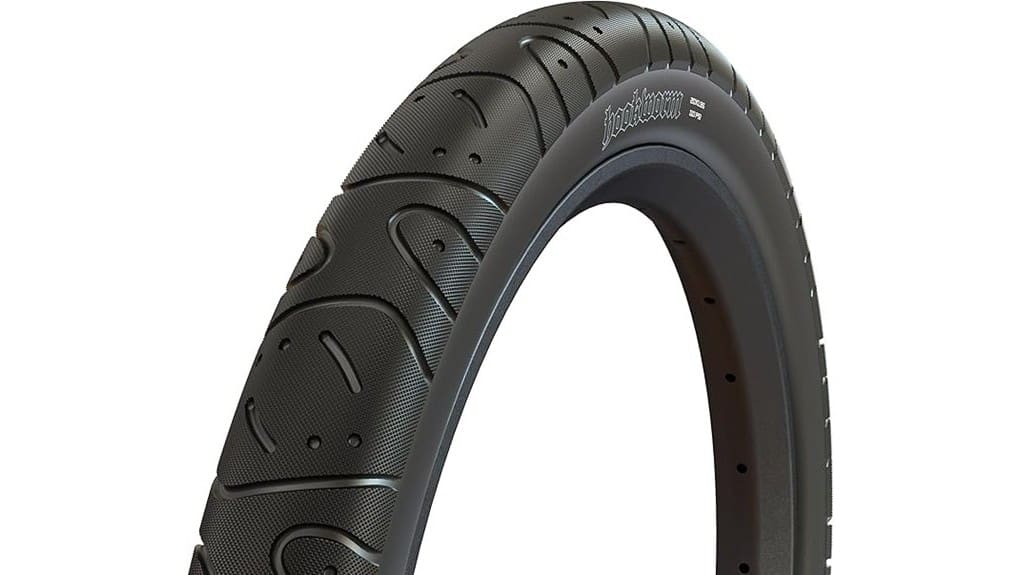
You’ll like the MAXXIS Hookworm if you want a durable, fast-rolling urban tire that corners with predictable grip. Its continuous wraparound tread and single durable compound deliver consistent braking and lateral traction while minimizing rolling drag versus knobbier BMX tires. Thick carcass plies and reinforced beads resist cuts and pinch flats for commuting, cruising, park runs, or BMX tricks. Fitment needs careful clearance and rim-width checks, and the one-year warranty covers manufacturing defects — more technical details follow.
Some Key Takeaways
- Durable single-compound rubber and thick carcass deliver predictable grip and long service life for urban and BMX use.
- Wraparound low-profile tread offers fast rolling, consistent braking, and confident cornering on asphalt and concrete.
- Reinforced bead and sidewalls resist cuts and pinch flats, favoring reliability over minimal weight savings.
- 20 x 1.95 fit requires checking rim inner width and frame clearance for proper seating and safe inflation.
- Higher upfront cost offsets lower per-mile replacement and comes with a one-year manufacturing defect warranty.
Why Shoppers Choose the MAXXIS Hookworm Tire (Quick Verdict)
Often you’ll pick the MAXXIS Hookworm because it pairs rugged, single-compound rubber with a wraparound tread that delivers exceptional grip and fast rolling on street, park, and cruiser bikes. You want a tire that resists punctures and maintains predictable handling; the Hookworm does both with minimal rolling drag compared to knobbier BMX tires. Its low-profile footprint favors urban aesthetics without sacrificing contact patch stability, so you get nimble steering and confident cornering. For riders seeking freedom—commuting, cruising, or probing city limits—this tire boosts rider confidence through consistent feedback, durability, and efficient momentum retention. Clip-on fenders can be a great accessory to keep your Hookworm-equipped ride clean and dry, especially when riding in wet urban conditions with clip-on bike fenders.
How the Hookworm’s Tread, Compound, and Build Deliver Durability and Grip
Because Maxxis combines a wraparound tread, a single durable rubber compound, and rugged construction, the Hookworm delivers a balanced blend of long wear and confident grip on hard surfaces. You’ll notice the continuous tread flank increases contact patch consistency versus segmented patterns, improving braking and lateral traction on asphalt and concrete. The single compound minimizes compound aging variables, so grip remains predictable as mileage accumulates. Thick carcass plies and reinforced bead areas resist cuts and deformation, prioritizing tread longevity over marginal weight savings. For riders who value dependable traction and low maintenance, the Hookworm’s build is deliberately utilitarian. Maxxis’s focus on providing reliable urban performance is reflected in their lineup of tires designed for commuting durability.
Real-World Performance: Street, Park, Cruiser, and BMX Use Cases
Having established how the Hookworm’s wraparound tread, single compound, and robust carcass promote longevity and predictable grip, you can now see how those traits play out across specific riding contexts. On streets you’ll notice stable corner carving at speed and confident braking on varied surfaces. In parks the super-fast rolling aids transfer between features while the carcass resists pinch flats during aggressive lines. As a cruiser tire it soaks pavement irregularities, letting you roam freely. For BMX you’ll exploit curb hopping and pump track speed without sacrificing traction for flatland tricks. Durable, predictable, and tuned for urban freedom. Comfort bikes prioritize rider ease and stability with wider seats and relaxed geometry, making them ideal for casual riders seeking comfortable, joyful rides.
Sizing, Fit, and Installation Tips for 20 X 1.95 Hookworm Tires
When swapping in a 20 x 1.95 Hookworm, plan around its true bead-to-bead width and robust sidewalls so the tire seats and clears rims, forks, and chainstays without rubbing. Measure wheel clearance before purchase; compare advertised width to measured rim inner width and frame spacing. Use proper bead seating technique: align bead, inflate in short bursts, and secure valves to avoid burping. Favor rims with wider inner widths for stable profile and lower pressure freedom. Inspect for uniform bead seating around the rim, then torque axle and recheck clearance under load. You’ll get durable, fast rolling fitment when you follow these steps. Also consider inner tube compatibility and valve type when selecting a tube to ensure proper fit and performance with the Hookworm’s casing and rim inner width.
Value and Warranty: Price, Longevity, and What the One-Year Warranty Covers
While the Hookworm’s upfront price often sits higher than generic cruiser tires, you’ll recoup value through extended service life and fewer flats thanks to its single-compound rubber and rugged construction. In a cost comparison, per-mile expense favors Hookworm when you factor reduced replacement frequency and lower downtime. Expect predictable wear patterns; longevity outperforms softer compounds in urban and BMX use. The one-year warranty covers manufacturing defects to the original retail purchaser but has clear warranty limitations: it ends after one year or when original tread depth is no longer serviceable, and excludes damage from misuse, normal wear, or improper installation. Many riders also appreciate that Hookworm tires are available in a range of widths suitable for different frames and riding styles, making them a versatile choice for cruiser and BMX applications.
Some Questions Answered
Are These Tires Tubeless-Compatible?
No, they’re not tubeless-ready out of the box. You can attempt a tubeless conversion, but you’ll need careful rim tape compatibility checks and likely a tubeless rim or tight bead rim to seal reliably. Compared with modern tubeless-specific tires, the Hookworm’s single-compound bead and design prioritize durability over airtight sealing. If you crave tubeless freedom, choose a tubeless-design tire or confirm your rim’s inner width and tape specs before converting.
What PSI Range Is Recommended for Different Rider Weights?
For rider weightbands, aim 30–45 PSI for riders under 140 lb, 40–55 PSI for 140–200 lb, and 50–65 PSI for over 200 lb; consult a pressure chart for terrain and load adjustments. You’ll prefer lower pressure for comfort and grip, higher for puncture resistance and speed. Compare settings by testing: softer equals traction, firmer equals efficiency. You’re free to tune within bands for personal feel and conditions.
Can I Use Them on Electric-Assist Bikes?
Yes—you can use them on many e-bikes, but check e bike compatibility and motor torque limits. The Hookworm’s single-compound, rugged construction handles higher loads and rolling forces better than lightweight street tires, offering puncture resistance and grip. However, high-torque mid-drive or hub motors can accelerate wear; if your motor torque is substantial, opt for tires rated for e-bike use or reinforced casings to preserve longevity and safety.
Do They Come in Other Colors or Sidewall Styles?
Yes — you’ll find limited color options and sidewalls styles. The Hookworm primarily ships in black, but aftermarket variants and some sellers offer whitewall or gum sidewall alternatives. Compare finish durability and UV resistance: black sidewalls maximize longevity, while lighter sidewalls trade durability for aesthetic freedom. If you want a specific color options or sidewalls styles, check vendor listings or custom shops for compatible Hookworm 20×1.95 replacements.
Are Replacement Inner Tubes Included or Required Separately?
No, replacement inner tubes aren’t included; you’ll need to supply one separately. You should choose a tube with correct tube compatibility for a 20 x 1.95 tire and preferred valve type. Compare butyl versus latex options: butyl offers rugged puncture protection and lower maintenance, while latex is lighter and faster but more permeable. Pick a durable butyl tube if you want reliable freedom from roadside flats and longer service intervals.