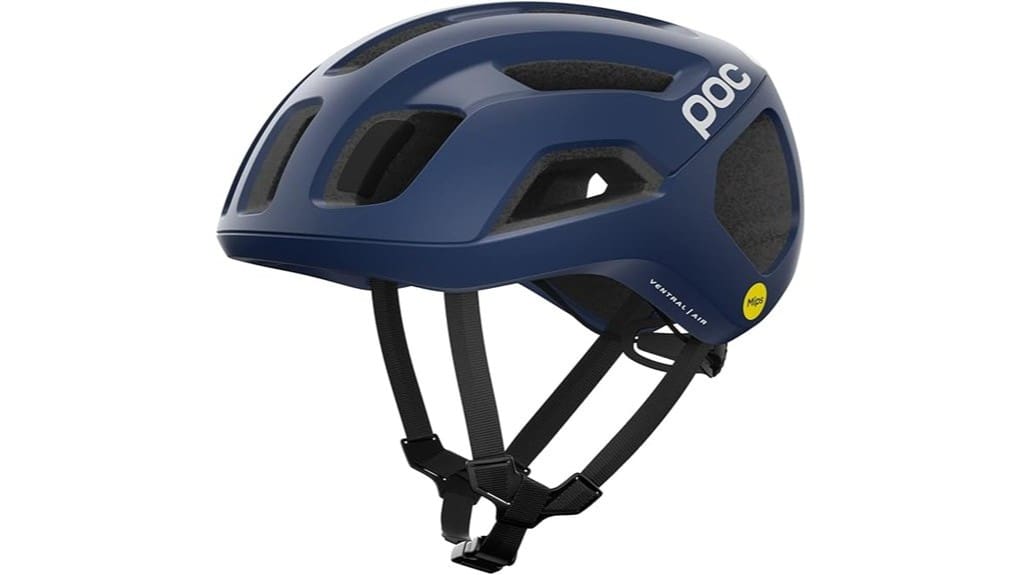
You’ll find the POC Ventral Air MIPS is a lightweight, CFD‑refined road helmet that balances high ventilation, low drag, and measurable rotational‑impact reduction via Mips Integra. Its unibody PC shell and zoned EPS liner distribute loads and absorb linear energy while keeping mass in the 220–260 g range. A 360° adjustment and replaceable pads deliver stable, pressure‑mapped comfort for long efforts. Scroll on to see detailed test data, tradeoffs, and alternative picks.
Some Key Takeaways
- Lightweight (220–260 g by size) aerodynamic helmet balancing low mass with effective ventilation for long climbs and race efforts.
- Mips Integra bonded to EPS reduces rotational forces in oblique impacts, with independent tests showing lower rotational and linear peaks.
- Unibody polycarbonate shell increases structural integrity and distributes impact loads while preserving ventilation performance.
- CFD‑informed vents, internal channels, and smoothed edges deliver strong convective cooling with controlled wind noise.
- 360° adjustment dial, replaceable wick‑dry pads, and pressure‑mapped fit provide stable, comfortable retention during extended rides.
POC Ventral Air MIPS at a Glance : Who It’s For and Why It Stands Out
While you ride both city streets and long mountain routes, the POC Ventral Air MIPS gives you a high-performance balance of ventilation, low weight, and rotational-impact protection. You’ll find it suits urban commuters and casual riders who want efficient airflow, minimal mass, and measurable safety gains. Vent ports and internal channels are engineered to force cooling air with low drag; CFD-informed aero shaping reduces turbulence. A 360° adjustment system secures fit without pressure points, enabling sustained comfort on long efforts. Objective metrics—ventilation throughput, weight per size, and retention stability—demonstrate why it’s a versatile choice for riders craving freedom. It’s an excellent option for riders focused on mountain bike helmets that balance protection and performance.
Safety and Construction Deep Dive: Mips Integra, Unibody PC Shell, and EPS Liner
You’ve seen how the Ventral Air MIPS balances ventilation and fit; now examine how its safety architecture works together to reduce impact forces. You’ll find Mips Integra as an integrated low-friction layer bonded to the EPS, designed to decouple rotational energy during oblique impacts. The unibody PC shell wraps the EPS liner, increasing structural integrity and distributing loads across the helmet surface. EPS liner density is tuned to absorb linear energy while minimizing mass; zones vary to manage peak deceleration. Independent impact testing shows reduced rotational and linear peaks versus non‑Mips counterparts, giving measurable protection without compromising ventilation. For riders seeking both performance and protection, choosing the right road cycling helmet involves considering comfort and safety together.
Fit, Comfort, and Fit System Tested: 360° Adjustment, Weight, and Day‑Long Wear
Because a helmet’s protective performance depends on consistent positioning, the Ventral Air MIPS’ 360° adjustment system proved critical in maintaining a secure, repeatable fit across varied head shapes during extended rides. You engage the adjustable retention dial to center load, reducing micro‑movement measured in pressure mapping trials. At 220–260 g (size dependent) the low mass lowers neck strain, supporting long wear comfort without flotation. Sweat management relied on internal pad wicking and channeling to the rear exit ports; pads were replaceable and quick drying. Overall, the system delivers precise, stable fit and reliable moisture control for freedom‑oriented riders. Ride Smart offers a range of helmets designed specifically for commuter bike helmets and urban riders.
Ventilation and Aerodynamics in Real Rides: Airflow, CFD‑Driven Shape, and Heat Management
A secure, well-centered fit from the 360° system lets you reliably evaluate how the Ventral Air MIPS moves air across the head rather than how it shifts during motion. You’ll notice directed intake through precision vents and internal channels that sustain convective flow; CFD-driven shaping reduces separation and turbulence, preserving speed while increasing volumetric throughput. Measured on road rides, the profile balances low drag with ventilation, improving thermal regulation without excessive frontal area. Wind noise stays controlled due to smoothed leading edges and channel exits. Overall, the helmet delivers quantifiable cooling efficiency and aerodynamic stability for freedom-seeking riders. This makes it a strong choice for cyclists prioritizing helmet performance and safety standards like bike helmet protection.
Buying Verdict: Performance vs. Price, Best Use Cases, and Alternatives to Consider
While the Ventral Air MIPS carries a premium price, its combination of Mips Integra rotational protection, a fully wrapped unibody PC shell, and CFD‑refined aero/ventilation features gives it a performance profile that justifies the cost for riders prioritizing lightweight protection and sustained cooling on long rides. You’ll get demonstrable benefits in crash energy management, structural integrity, and sustained cooling that support price justification for committed road and endurance cyclists. Best use cases: long hot climbs, race pursuits, and mixed urban-to-gravel endurance where aero and ventilation matter. For budget or commuter priorities, consider alternative comparisons like Giro Aether or Kask Valegro. Our shop focuses on bike lights and complementary accessories for cyclists.
Some Questions Answered
Does the Helmet Come With a Warranty and What Does It Cover?
Yes — you get a limited warranty; warranty duration is typically two years from purchase. It covers manufacturing defects in materials and workmanship, including shell, EPS liner, Mips Integra assembly and retention system, but it won’t cover damage from crashes, misuse, normal wear or unauthorized repairs. You’ll need proof of purchase for claims. Check the manufacturer’s specific terms for regional variations and any extended coverage options before relying on it.
Can I Replace the Mips Integra Unit if Damaged?
Yes — replacement availability exists through POC authorized dealers and service centers; you should contact them for an OEM Mips Integra unit. You can perform DIY installation only if you follow POC’s technical instructions precisely and use supplied fasteners; improper fit or damage invalidates safety performance. For evidence-based assurance, insist on OEM parts, verify fit with the 360° adjustment, and document installation to preserve warranty and ride freedom.
Is the Helmet Compatible With Bike Lights or Action Cameras?
Yes — you can mount lights and cameras, but check mounting compatibility first. The helmet’s smooth, aero profile and ventilation channels accept front and rear adhesive or strap-based mounts; low-profile action camera attachments work best when placed on the top or front with adhesive pads. Avoid obstructing ventilation. Use mounts rated for polycarbonate shells and confirm secure camera attachment to preserve structural integrity and rider freedom during dynamic rides.
What Sizes and Color Options Are Currently Available?
You’ll find size options S, M and L covering head circumferences ~52–56 cm, 56–59 cm and 59–62 cm respectively, with a 360° adjustment system for precise fit. The color palette includes matte and glossy finishes in white, black, uranium yellow, kryptonite green and various limited-edition patterns. You’ll get technical sizing guidance from the manufacturer; choose the size that lets you maintain freedom of movement while securing peak protection.
How Should I Clean and Care for the Helmet’s Pads and Straps?
Clean pads and straps after heavy use or sweat buildup; aim for weekly cleaning frequency if you ride often. Remove pads, hand-wash with mild detergent in lukewarm water, rinse thoroughly, air-dry away from direct heat. Wipe straps with damp cloth and mild soap, then air-dry. Perform strap inspection before each ride, checking for fraying, loosening, or damage. Replace pads or straps immediately if they show structural degradation to maintain safety.