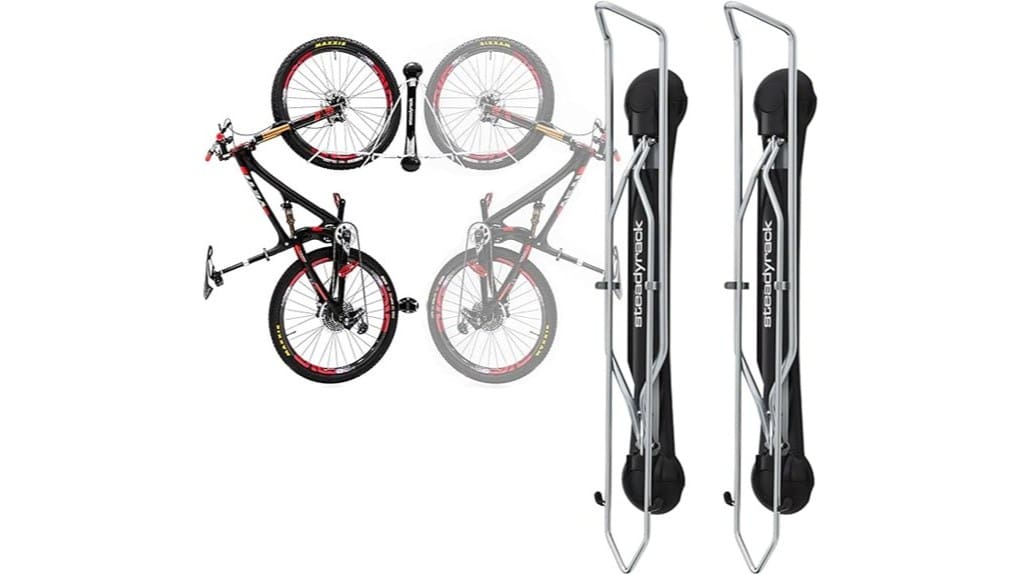
You’ll like the Steadyrack MTB Rack if you need compact, heavy-duty bike storage that makes rolling heavy trail bikes and eMTBs into tight garages or apartments easy. It supports up to 77 lb, 24″–29″ wheels and roughly 2.1″–2.8″ tires, with a pivoting rear cradle that smooths loading and keeps the bike close to the wall. Installation needs solid anchors or studs, but once mounted it folds flat and resists scuffs—keep going for full setup, fit, and alternative options.
Some Key Takeaways
- Roll-in design lets you load heavy trail bikes and eMTBs by balancing on the rear wheel, minimizing lifting effort.
- Patented pivot stores bikes close to the wall, folding flat to save space in tight garages or apartments.
- Heavy-duty construction supports up to 77 lb (35 kg) and fits 24″–29″ wheels with ~2.1″–2.8″ tires.
- Best mounted into studs or solid masonry; use proper anchors, level installation, and test with weight before use.
- Not suitable for oversized eBike tires, full-coverage mudguards, or freestanding storage needs.
Quick Verdict: Is the Steadyrack MTB Rack Worth Buying?
Although it’s compact enough for tight garages and apartments, the Steadyrack MTB Rack stands out because it actually makes loading heavy trail bikes easy—you roll the bike in, balance on the rear wheel, and the patented pivot stores it close to the wall. You’ll appreciate the clear value proposition: heavy-duty build, fold-flat convenience, and low lift effort for big eMTBs and rigs. If you crave liberated space and quick access, this rack delivers. Consider purchase timing around moves or offseason storage; buy when you need liberated floor space and minimal setup hassle. It’s worth it for freedom-focused riders. It also complements other indoor bike storage solutions like wall mount systems designed for showcasing your bike inside.
Specs and Fit: Weight, Wheel and Tire Compatibility, and What Bikes It Supports
For tight storage needs, the Steadyrack MTB Rack supports most trail rigs you’ll own: each rack holds up to 77 lb (35 kg), fits 24″–29″ wheels, and accommodates tire widths from about 2.1″ to 2.8″. You’ll appreciate precise wheel clearance for knobby tires and minimal wall gap when parked. The roll-in design reduces lifting, letting you position heavy eMTBs while maintaining proper load balance on the rear wheel. It suits hardtails, full-suspension trail bikes, and many eMTBs without fenders. Check tire width and frame geometry before buying; overly wide mudguards or odd axle standards can compromise fit. Many customers choose vertical racks to both save space and showcase bikes in tight garages.
Real-World Performance: Loading, Pivoting, Durability, and Day-to-Day Use
Get your bike onto the Steadyrack MTB Rack by rolling the rear wheel in—its patented roll-in design really cuts the lifting you’d expect with heavier trail and eMTB setups. You’ll notice refined mountain bike ergonomics: the rear-wheel cradle aligns naturally, so pivoting the SteadyPivot is smooth and predictable. Daily maintenance workflow improves because the bike sits stable and accessible for quick checks, tire pressure, or chain lube. Chrome plating resists scuffs; the heavy-duty build shows little flex under repeated use. Day-to-day, the rack folds flush, saves space, and feels engineered for freedom without fuss. Our Perfect Bike Display Stands collection includes complementary options to suit different rider needs, like compact wall mounts and freestanding models designed for home use with space-saving designs.
Installation and Setup: Tools, Mounting Tips, and Common Mistakes to Avoid
Before you drill, gather a cordless drill, 10–12 mm masonry or wood bits (depending on your wall), a level, tape measure, pencil, and a stud finder; this prevents last-minute trips and guarantees you mount the Steadyrack MTB Rack where it’ll carry up to 77 lb securely. Use the mounting templates to mark hole centers, double-check stud locations, and set rack height for easy roll-in loading. Anchor into studs when possible; use proper anchors for masonry. Level before tightening. Common mistakes: ignoring stud locations, over-tightening hardware, and poor clearance planning. Follow the kit guide and test with weight before regular use. For compact spaces, consider wall-mounted solutions like bike storage racks to maximize floor space and organize multiple bikes.
Who Should Buy It (Or Skip It): Ideal Use Cases, Limitations, and Alternatives
While the Steadyrack MTB Rack excels when you need a robust, space-saving solution for trail bikes—especially heavy eMTBs up to 77 lbs and 24″–29″ wheels with 2.1″–2.8″ tires—it’s best for users who can mount it to studs or solid masonry and don’t run full fenders. You should buy it if you want rugged, fold-flat storage for garage, apartment, or shed and value the roll-in ease with heavy bikes. Skip it if you rely on full-coverage mudguards, need freestanding racks, or store commuter bikes or cargo eBikes with oversized tires or frames. Consider floor stands or ceiling hoists as alternatives. Ceiling storage solutions like ceiling bike hoists can be a great alternative when floor space is at a premium.
Some Questions Answered
Does the Rack Scratch Painted Rims or Frame Finishes Over Time?
No — you shouldn’t see scratches if you use it properly. The rack’s contact points include rubber padding that cushions rims and frames, providing finish protection during roll-in and storage. You’ll still want to clean grit from tires and avoid prolonged wet contact to prevent abrasive wear or corrosion. Install securely, center the wheel, and fold flat when not used to preserve paint and enjoy worry-free, freedom-oriented bike storage.
Can Two Racks Be Mounted Side-By-Side for Tandem or Bike Stacking?
Yes — you can mount two racks side-by-side for tandem mounting or stacked storage. You’ll position them to suit wheelbase and handlebar clearance, letting you roll one bike in then the next. Make certain wall studs and fasteners meet load ratings for combined weight (up to 77 lbs per rack). Measure tire widths (2.1″–2.8″) and wheel sizes (24″–29″) to avoid contact, and leave room to pivot bikes toward the wall.
Is the Chrome Finish Prone to Rust in Humid Environments?
No — the chrome finish isn’t overly prone to rust, but you should practice chrome care because humid environments speed corrosion. You’ll want to wipe the rack dry after damp exposure, apply a light protective wax periodically, and check welds and fasteners during routine humidity testing. If you live near coastlines or high-salt areas, consider extra protection or indoor placement to preserve the finish and maintain long-term reliability.
Are Replacement Parts (Pivot, Arm) Available Separately?
Yes — you can get replacement pivots and arm spares separately. You’ll contact Steadyrack or an authorized dealer for part-specific orders (pivot, arm), and they’ll confirm compatibility with the B-SRMTB-001. Expect genuine carbon-steel/ABS components, limited stock, and a nominal charge beyond warranty. You’ll want proof of purchase for warranty claims; otherwise you’re free to buy parts outright and install them to keep your rack rugged and functional.
Can the Rack Be Installed on Plasterboard Without Studs?
No — you shouldn’t install the rack on plasterboard without studs. Drywall anchors or adhesive mounts might seem tempting, but even heavy-duty anchors rarely match studs for a 77 lb load and dynamic forces when mounting a bike. You’ll compromise safety and risk wall damage. Instead, locate studs or install plywood backing across studs to spread loads. That keeps your freedom to store bikes securely without constant worry.